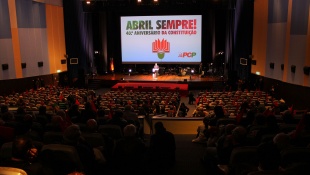
The Constitution of the Portuguese Republic, which Álvaro Cunhal, upon its approval, affirmed to be the “testimony of history,” the “faithful portrait of the Revolution,” was an important victory for our people, for the democratic forces and the military of April, enshrining in fundamental law the achievements and values of the April 25th. Revolution, which are still deeply felt today.
Besides fundamental rights and freedoms, including a broad set of social rights that remain enshrined to this day, its original text went further in terms of objectives and guidelines for a fairer more developed, and sovereign Portugal.
It stipulated, as fundamental tasks of the State: ensuring the socialisation of the means of production, nationalisations and the duty to carry out Agrarian Reform, the egalitarian distribution of wealth and income, supported structurally by an adequate tax system, and the irreversibility of the elimination of monopolies and large landholdings.
A Constitution with democratic and progressive content, the fruit of the struggle of the workers and the popular masses, in which the communists participated and contributed indelibly.
This same original text of the Constitution, it's worth remembering, was approved on April 2, 1976, by a large majority of the members of the Constituent Assembly.
This original text was promulgated here in the Assembly of the Republic immediately after its approval by the then President of the Republic, General Costa Gomes.
Today's text is not the same as that of 1976, but despite the mutilations suffered in successive amendments, the Constitution still enshrines essential rights and constitutes the basis for the path that Portugal needs.
For the PCP, this is an essential issue, and the question that arises is what opinion other forces will have, especially those that, after the counter-revolutionary coup of November 25, 1975, tried everything to reverse its contents and then to prevent its proclamation.
What opinion will those have who, through their political choices, have not only prevented and continue to prevent the fulfilment of the Constitution but have also promoted and continue to promote its subversion and the denial of its values?
What position will those have who, like the PSD, CDS, and PS, have conspired not to fulfil and enforce the Constitution, but rather to amend and continuously amend it, as exemplified by the seven constitutional amendments already?
And what will Chega and IL, the most visible and vocal defenders of big economic and financial capital, those who have always viewed and continue to view the Constitution as an obstacle to the full reconstitution of lost power, say?
Some in a more dissimulated way, others openly, constitute themselves as adversaries and enemies of the Constitution, accomplices and responsible for its non-compliance.
Of the blows that the seven amendments dealt to the fundamental law, we emphasise the strategic importance of two.
The first was the elimination of the constitutional protection of the principle of the irreversibility of nationalisations and Agrarian Reform, which widely opened the doors to the economic crime of privatisations and destroyed the most beautiful achievement of the revolution, the Agrarian Reform.
The second was the changes introduced within the framework of the capitalist integration process in the European Union.
Changes that resulted in the weakening of national sovereignty and independence.
Changes that shaped a new path for the Country, but which did not legitimise, nor do they legitimise, the unconstitutional policies of successive governments, with the tragic consequences that are clearly visible in Portuguese society.
It was the results of these political choices that brought the Country to a reality where the fundamental levers of our economy are in the hands of and at the service of monopoly capital, particularly foreign capital, with sovereignty and the right to development jeopardised.
A counter-revolutionary process of liquidating rights, settling scores with the April Revolution, and evident subversion, attack, and constitutional amendment.
A process that continues.
This was the case in 2022 with the attempt at a new constitutional amendment by the PSD, Chega, and IL parties, an objective they did not abandon.
A path that only did not go even further because the struggle of the workers, the people, and the youth did not allow it; because the profound transformations achieved with the 25th. of April are alive in the collective consciousness; because the Constitution continues to be an important weapon in the defence of democracy and corresponds to the desires and aspirations of the majority.
Despite being mutilated, the Constitution not only guarantees fundamental rights but also enshrines the options and the path to confront the Country's structural deficits and respond to the difficulties faced by our People.
What is needed is a return to the path of the Constitution, not political options that increase injustices and inequalities to serve a minority that concentrates increasingly more wealth.
What is needed is a return to the Constitution and a break with the path that subjects the Country to backwardness and disinvestment, and that subjects it to the vassalage of those who wage war, to the detriment of the sovereignty, independence, and interests of our Country.
What is needed is to translate into the lives of all each of the rights enshrined in the Constitution and to combat the options of the current government and its agenda at the service of economic groups.
An agenda to maintain low wages and pensions, impose the Labour Package, go ahead with privatisations, and attack public services, at the outset with the dismantling of the National Health Service, the weakening of Public Schools, and the assault on Social Security.
The Constitution enshrines the path that confronts this policy.
If the Constitution affirms that workers' rights are intrinsic to democracy, from union rights to labour rights; if it enshrines job security and a fair redistribution of wealth through the right to fairer wages; if it guarantees women the right to equality; children protection aimed at their integral development; young people special protection for the materialisation of their economic, social, and cultural rights; pensioners the right to economic security and housing conditions that respect their autonomy and prevent isolation or social marginalisation; people with disabilities the guarantee that the State will ensure the implementation of their rights; if the Constitution subordinates economic power to political power; if it defines that it is the State's responsibility to prioritize economic and development policies that ensure social well-being and quality of life, social justice, and economic and social cohesion throughout the national territory; if the Constitution provides for public ownership of natural resources and means of production, in accordance with the collective interest; if it enshrines a democratic and autonomous Local Government; democratic planning and the participation of workers' representative organisations in defining economic and social measures are established; an economic organisation based on a mixed economy, in which the public, private, cooperative, and social sectors of the means of production coexist, neither monopolistic nor based on large landholdings; the Constitution establishes as obligations of the State healthcare, social security, culture, housing, education, and enshrining free compulsory education and the right of access to the highest levels of education; the Constitution defines that the country is governed by the principles of equality between States, the peaceful settlement of disputes, and non-interference in the internal affairs of other States; the Constitution stipulates the abolition of imperialism, colonialism, and any other forms of aggression, domination, and exploitation in relations between peoples, as well as general, simultaneous, and controlled disarmament, the dissolution of military blocs, and a system of collective security; If all of this is enshrined in our Constitution, if all of this represents the needs and responses of the workers, the population, the youth, and the Country, then it is not the Constitution that is wrong, but the disastrous right-wing policy that fails to comply with it.
Precariousness, injustice, inequalities, difficulties in accessing healthcare, housing, and education, poverty, the unfair distribution of created wealth, the power of economic groups, the loss of sovereignty, and war—all hallmarks and consequences of right-wing politics—are profoundly unconstitutional.
Therefore, let every worker, young person, woman, pensioner, entrepreneur, farmer, fisherman, artist, researcher, scientist, student, every mother and every father, embrace this Constitution for what it is: an instrument for each individual, at their service and at their disposal.
An instrument to be known, defended, claimed, and implemented daily, every day of our lives.
The Constitution is a reference point in the struggles being waged today in defence of popular interests; it is an important and indispensable instrument against the politics that affront it, the right-wing politics now carried out by the current PSD and CDS government, with their accomplices in IL and Chega, and with the acquiescence of the PS.
Due to the advanced and progressive character it still holds, the content of the constitutional text continues to be a point of convergence for democrats and patriots who aspire to a developed Portugal, one of progress and social justice, and a weapon in the defence of the rights of the workers and people.
It is in the Constitution that patriotic and left-wing politics, a true alternative politics capable of solving national problems and ensuring the sovereign development of the country, finds its inspiration and reference point for its implementation.
If the Constitution is effectively respected in its principles, if its broad conception of political, economic, social, and cultural democracy is implemented, if the affirmation of national sovereignty and independence is pursued, if the rights and project it enshrines become reality, Portugal will be a different country for the better, more developed, with less injustice and social inequality, sovereign, with better conditions to face the challenges that the present and the future present.
This is the challenge facing everyone, and particularly the youth and new generations.
Take your fundamental law into your own hands, take into your own hands the materialisation of the project that responds to your aspirations, interests, and rights.