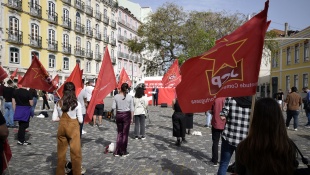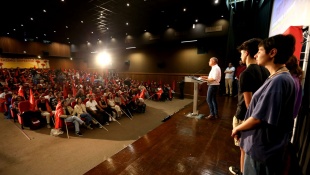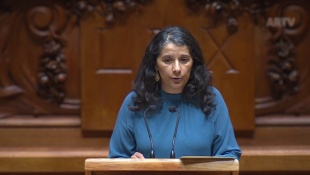
Today, as yesterday, the youth take the destiny of their lives into their own hands, they do not conform, nor do they resign themselves, and with the irreverence and creativity that characterises the youth, they fight. They fight for their rights, they fight for a decent life, they fight for the future to which they are entitled, they fight so that Article 70 of the Constitution on youth becomes a reality for all young people in our country—an article that states, and I quote: "young people enjoy special protection for the materialisation of their economic, social and cultural rights, notably in education, vocational training and culture, access to first employment, work and social security, access to housing, physical education and sport, and the use of leisure time."
However, real life is quite different. Dreams are systematically postponed by a difficult life, by the perspective of a future. Having a home, an independent life, starting a family—for thousands and thousands of young people, this is increasingly a distant mirage. Leaving their parents' home and being able to rent a place to live, is currently beyond the reach of the vast majority of young people; at best, they have a room, sometimes shared, or a house shared by three or four other people just to be able to pay the bills. Housing prices are at an all-time high. The PSD and CDS Government, along with their supporters—the Iniciativa Liberal and Chega—must be extremely pleased. This is the result of the measures implemented by the government. Reality is proving that these measures solve no problem; they are only exacerbating the problems and constitute a real incentive for price increases and speculation. And, not satisfied with that, they intend to worsen the situation by making evictions easier. The government has not yet explained how pushing families onto the street will solve any housing problem. Obviously, it won't. It will only weaken and make the situation more precarious for tenants. There are rental values that are higher than the wages, and the government still grants tax benefits to those who have been profiting from speculation for decades—with rents of up to €2,000—and now wants these tax benefits extended to rents of up to €2,300. Most young people have a salary of less than €1,000. It is necessary to explain how it is possible to access housing with this type of income.
Many young people—thousands and thousands of them—have precarious contracts, and we all know that precarious work means precarious life. It doesn't provide stability, it doesn't provide security, it doesn't allow them to truly organise and build their lives. And what the government has to offer young workers is low wages, more precariousness and exploitation, more deregulation of working hours, and easier dismissals—with the labour package they want to force through. For the government and employers, young workers are just another machine piece, exploited and discarded when they are no longer needed. It is against this outdated legislation that young workers will take to the streets next Saturday demanding their rights, demanding guarantees, and demanding that they be respected in the labour world—that there be, in fact, a valorisation of labour, an end to precarious work, an end to the deregulation of working hours, and a decent life to which young people are entitled.
On the other hand, students are hurt by policies of disinvestment and devaluation of public schools. To this—and we can only characterise it in this way—the statements made by the Minister of Education this week were provocative and reveal his conception, and that of the government, regarding education. For the government, education is not a right, it is a privilege. While passing the costs on to families, the government renounces its responsibility to ensure the funding of higher education institutions. We all know how tuition fees and other fees and charges are an obstacle to accessing higher education. Indeed, it is no coincidence that this academic year there has been a drop in the number of students entering higher education—and this is not unrelated to the costs of attending higher education, nor to the difficulties faced by families and students. Last week, we tabled concrete measures to strengthen school social action and support for student housing, namely the student housing supplement. And the truth is that this government not only fails to solve these problems but also prevents measures to solve them from being adopted. This makes it very clear what its preference is: an increasingly elitist higher education system, in which the children of workers have no place.
Regarding higher education issues, it is also important to highlight the lack of democracy in institutions, both at the university and secondary levels. These are also aspects that students are raising as fundamental for a country that should be democratic. The lack of democracy in schools is unacceptable. The interference that often occurs in secondary schools—preventing students from holding general student meetings, interfering in the electoral processes of the student associations themselves—is inadmissible. But, just as students were fighting in higher education, they are also fighting in secondary education, demanding investment in school infrastructure, demanding the hiring of necessary teachers, psychologists, and staff, and the removal of obstacles to accessing higher education, such as entrance exams. And we want to express our full support for these struggles.
The government — PSD, CDS and those who support them, the Liberal Initiative and Chega — does not want a country for young people; it forces them to emigrate and seek a better life abroad, which they cannot find in Portugal. This demonstrates that this policy — the policy of the right — does not serve. It is responsible for jeopardising and mortgaging the lives of young people. And what the situation demands is a break. A break with this policy. It demands an alternative policy that provides a perspective for the future, a decent life, and that guarantees the rights of young people.