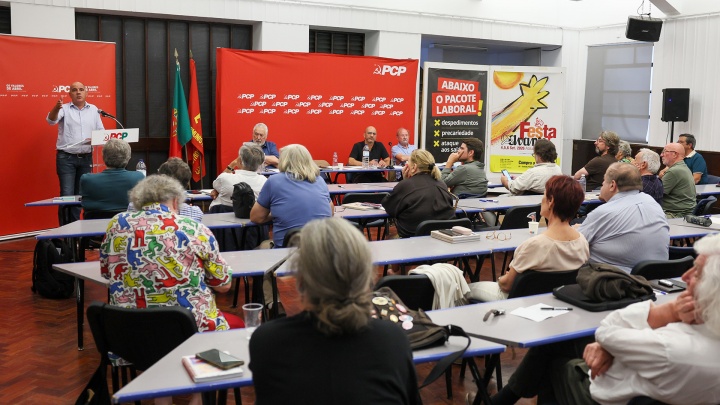
Dear comrades, dear friends, I would like to extend my greetings to all those taking part in this meeting with micro, small and medium-sized entrepreneurs, which in itself is a very important sign of the attention and support we are giving to this vital national reality, which involves more than 500,000 companies, very diverse, and constitute a substantial part of the Portuguese economic fabric.
Only the PCP would be in a position to organise a meeting with this composition and with the content we have heard here throughout the day.
The Party’s Programme states that the economic development project for the Advanced Democracy that we propose for the Country requires: “a mixed economic organisation, not dominated by monopolies, with diversified sectors of ownership, each with its own complementary dynamics, respected and supported by the State, namely:
- a private sector, comprising enterprises of varying sizes (in industry, agriculture, fisheries, commerce and services), with small and medium-sized enterprises standing out for their flexibility and their weight in production and employment (...)’;
- a mixed economy “where (...) the necessary conditions are guaranteed so that small and medium-sized entrepreneurs (...) can contribute more effectively to social production”.
The Party’s Constitution states, in addressing the social alliances necessary for “the deepening and defence of democracy”, that the PCP must commit itself “to the creation of a broad social front encompassing workers, employees, intellectuals and technical cadres, small and medium-sized farmers, and small and medium-sized entrepreneurs in commerce, industry and services (...), social forces that play a part in national life with specific aspirations and objectives”.
That said, and with the backing of the Party’s Programme and Constitution, I would like to emphasise the following: communist entrepreneurs are not in the PCP merely as a favour; they are not separate militants; they are, and must be, increasingly fully committed to this Party, which is their Party.
They are, and must be, increasingly fully committed as what they are: citizens who invest capital in creating structures for material production, the provision of services, and the commercial exchange of goods and services; who generally employ staff; and whose aim is to make a profit.
A reality that neither obscures nor negates the conflicting interests between the economic and social status of MSMEs and wage earners, including their own.
But it is this very reality which, in the historical era in which we live, compels us politically to articulate these very contradictions, in order to confront the economic, social and political power of big capital.
It is this very power that oppresses and subjugates various social strata and sectors, which objectively strengthens and favours the convergence of these very strata and sectors in the struggle against right-wing politics, which defends and serves the interests of big capital.
It is big capital, economic groups and multinationals that are expanding large retail outlets, shopping centres and retail chains.
Which dominates the banking sector and manipulates credit and interest rates.
It is big capital that absorbs the lion’s share of almost all EU funds and State support.
It is big capital that benefits from tax exemptions and privileges.
It is big capital that controls the State apparatus through its henchmen – ministers, secretaries of state, directors-general, etc. – shaping and tailoring the law and public intervention to suit its own interests and profits.
It is big capital which, through its own confederations, turns the PSD/CDS Government into its mouthpiece, as we heard again recently in connection with the Labour Package.
The main conflict in national life pits big capital, economic groups and multinationals against workers, but also against the vast majority of small and medium-sized entrepreneurs and farmers, who are being exploited by large companies that use and abuse their monopoly position and squeeze small companies and producers to the limit.
Small businesses and producers are often completely dependent on and at the mercy of the big players, particularly the large retail chains, which systematically breach competition laws whilst the Competition Authority stands idly.
MSMEs are therefore not only allies but – and we need them to be increasingly so – key players in this whole struggle to defend their own interests, in the face of big capital, which is indeed responsible for the difficulties faced by micro, small and medium-sized enterprises.
Difficulties that stem from high fuel and electricity prices, which line the pockets of the monopolies that dominate the sector.
Stem from bank charges, exorbitant interest rates and insurance premiums that line the pockets of the financial sector.
Stem from the costs of tolls, telecommunications and commercial rents, which are becoming increasingly exorbitant and are inextricably linked to the growing speculation that diverts millions into real estate funds.
We often hear the Government – this one and others – talk about companies.
But the companies this Government defends are those that already dominate the national economy and take the lion’s share of the wealth produced in our Country.
They are the banks which, with the exception of CGD, are for the most part in the hands of foreign capital.
They are the large retail groups, Jerónimo Martins and SONAE, alongside multinationals such as Lidl and Mercadona.
They are the economic groups that control the energy sector, telecommunications, and the motorway, port and airport concessionaires.
They are the investment funds that make millions from financial speculation, or the economic groups that thrive on Public-Private Partnerships, through the multi-million contracts they sign with the State in sectors such as healthcare.
They are the foreign multinationals that dominate industrial sectors such as the automotive industry, platforms such as Uber, or the large digital companies that are becoming increasingly ubiquitous and powerful.
Ultimately, they are the privileged sectors of our country.
A few hundred families, shareholders and speculators who benefit from and support the current policy.
This was not the reality reflected in this meeting.
Your difficulties are not to be confused with the interests of those who consider themselves the owners of it all.
The majority of MSMEs, particularly micro-entrepreneurs, are men and women who work side by side with their workers; many of these companies are essentially family-run.
People who get up early and go to bed late, wondering how to keep their small businesses afloat – businesses to which they have often devoted their entire lives.
And reality is proving what we have said.
Micro, small and medium-sized entrepreneurs are currently facing a difficult situation.
As we have already shown, they are facing increasingly unbearable costs for energy, credit, communications and transport. They are grappling with the difficulties of a domestic market stifled by low wages.
They are confronted by a tax policy that favours those at the top and squeezes those at the bottom.
They are living from one loan to the next, such as those taken out as a result of the pandemic, which are only now being repaid.
In their day-to-day work, they have to deal with the colossal power not only of large suppliers, but also of large buyers who dictate the rules of the market, including prices.
They come up against the rules, regulations and guidelines of a European Union which, serving the interests of multinationals, couldn’t care less about small companies in Portugal.
This year, the structural problems affecting the Portuguese economy have been compounded by the impacts of storms and the imperialist aggression of the US and Israel against Iran.
As for the Government, there have been plenty of announcements and promises, but a lack of action.
With regard to the storms, and contrary to what the PCP proposed in the Assembly of the Republic, the Government has consistently refused to provide non-repayable grants, thereby pushing businesses into debt.
But the most scandalous thing is that, of the more than 8,000 applications submitted, totalling over 1,700 million euros, the bulk of this support for restoring productive capacity has yet to materialise.
As for the rise in fuel prices, the Government has made its choice by protecting GALP’s profits of over 1,000 million euros, rather than regulating prices and supporting small businesses.
The PSD/CDS Government, with the support of Chega and the IL, is pursuing a policy that works against MSMEs and the national economy.
This comes as no surprise to us and is nothing we have not seen before.
It was the PSD and the CDS who, for over 20 years, imposed the Special Advance Payment – a tax levy on micro-enterprises that only came to a definitive end in 2021 thanks to the decisive intervention of the PCP.
Or the VAT rate on catering, which rose to 23 % during the troika period through the imposition of the memorandum of understanding involving the PSD, the CDS and the PS, and which was restored to 13 % in 2016, again thanks to the decisive intervention of the PCP, although the remaining part relating to drinks has yet to be implemented.
And when we hear this Government talk about the supposed benefits of the IRC corporate tax cut, we know who this diversion of public resources is intended for – and it is certainly not for micro-enterprises, whose profits are essentially used to pay the salaries of the managing partners.
Yes, we could talk about fiscal policy.
We could talk about the “neglect” by successive governments regarding the high level of state aid (excluding EU aid) that most other European Union countries provide to their companies, and how this places Portuguese companies at a significant disadvantage.
We could talk about the role of the State apparatus, its countless departments, its bureaucracy – difficult tracks for MSMEs, and freeways for big capital.
The conclusion: right-wing policies severely penalise the vast majority of Portuguese micro, small and medium-sized enterprises.
Given the complex and serious economic situation facing the Country (and Europe, and the world), it would be demagogic to talk of easy solutions or a bed of roses for micro, small and medium-sized entrepreneurs.
There are solutions we do not recommend. For example, non-compliance with tax and environmental regulations.
There are solutions we do not accept, first and foremost policies based on cheap, precarious labour with no rights.
There is a path.
The path of fighting for policies that give priority support to the economic fabric of our micro, small and medium-sized enterprises and defend the domestic market and Portuguese production.
That is the path and the commitment of the PCP.
Starting tomorrow, at our Parliamentary Conference that we will be holding in Leiria and Coimbra, dedicated to the impacts of the storms and the solutions that are still lacking.
And in the coming weeks and months, when we will return to the Assembly of the Republic to push for a reduction in autonomous IRC rates, for the creation of a fund to support the cash flow of small businesses, for the regulation of trading hours currently tailored to the interests of large retail chains, for new commercial tenancy rules to curb property speculation, and for the regulation of gas, diesel and electricity prices.
Pela abolição de portagens nas autoestradas nas zonas metropolitanas.
For the abolition of motorway tolls in metropolitan areas.
Ultimately, for a policy centred on the needs of our economy and on the activities of micro, small and medium-sized enterprises.
For all these reasons, this meeting of ours must also serve as a significant boost to the struggle and organisation of MSMEs.
A strong and renewed commitment from communist entrepreneurs to participate in and revitalise their class-based organisations, starting with the Portuguese Confederation of Micro, Small and Medium-sized Enterprises, which we salute here.
A renewed and strengthened presence within the Party’s organisation.
So that the Party may understand their problems and transform them into political action and struggle
A fresh and renewed campaign amongst their class associations.
All of them, which include hundreds of MSMEs. Even those where, by their very nature, their leaderships push them into the sphere of influence of the major employers’ organisations representing big capital.
And I would like to make one thing clear here.
Your struggle – and that of all Portuguese MSMEs – in defence of their own specific interests is a struggle that converges with the struggles of Portuguese workers and with the struggle of the PCP for a break with right-wing politics, for a patriotic, left-wing policy serving the People and the Country.