On the conclusions of the European Council meeting of December 18 and 19, 2025
The European Council meeting held on December 18 and 19 was marked by the European Union's complete lack of concern for the economic and social problems affecting the lives of workers and peoples, by its insistence on a policy of confrontation, the arms trade and the prolongation of the war in Ukraine, and by its complicity with Israel's genocidal and colonial policy.
Issues such as the increase in the prices of essential goods and the deterioration of living conditions, the defence of public services in healthcare, education and social security, difficulties in accessing housing and the worsening of poverty were left at the doorstep of the meeting of the heads of state and government of the EU Member States and were not addressed or even mentioned by the European Council.
The problems and claims of small and medium-sized farmers, particularly with regard to the free trade agreement between the EU and MERCOSUR – which liberalises goods, services and public procurement – and other groups and sectors that have voiced their protest and indignation at being hit hard by European Union policies and decisions, are ignored, disregarded and disdained.
With regard to the next Multiannual Financial Framework 2028-2034, no steps have been taken to overcome the problems identified, for example by largely ignoring “economic, social and territorial cohesion” or the concentration of decision-making power in the European Commission and the use of the EU budget as a tool for political blackmail against Member States, among other serious and unacceptable aspects contained in the proposal presented by the European Commission.
In contrast, there is the omnipresence of the instigation of militarism, war hysteria and the promotion of the arms race as an across-the-board criterion in European Union policies.
The European Council has defined an accelerated pace for the implementation of measures decided in the framework of programmes aimed at increasing military spending, the arms trade and war, for the benefit of economic groups and multinationals.
Despite contradictions and open cleavages, the policy of confrontation and war continues to be promoted, with a negative emphasis on the insistence on prolonging the war in Ukraine, an objective for which billions of euros are being mobilised, financial resources which, it should be noted, are never available to address the economic and social problems affecting people's lives.
In this regard, the European Council has committed Member States (with the exception of the Czech Republic, Hungary and Slovakia) to a €90 billion loan, based on borrowing by the EU on the capital markets and backed by the EU budget, to prolong the war in Ukraine.
The confiscation of Russian assets enthusiastically advocated by Von der Leyen, António Costa and several Member State governments was not possible to enforce. However, despite warnings from the IMF and the ECB about the illegality of using Russian assets frozen in the EU, Belgium's assertion that the use of these assets would constitute theft, and the reservations and rejection of this measure by some Member States, the European Council continued to insist on the possibility of future measures regarding the use of Russian financial assets frozen by the EU, including possibly to “repay the loan” now decided upon.
The EU continues to adopt a stand that seeks to create obstacles to negotiation processes aimed at a political solution to the conflict in Ukraine, insisting on the factors that are at the root of the conflict and emphasising its confrontational attitude (political, economic-financial, military and legal), including the prospect of a new package of sanctions to be presented in January and the continuation of the warmongering rhetoric that frames its policies.
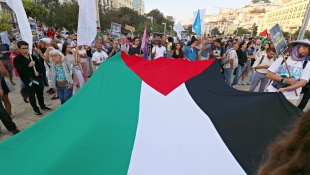
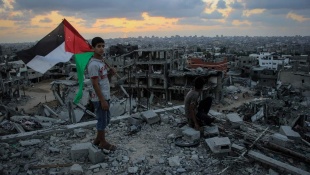
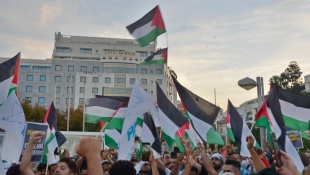
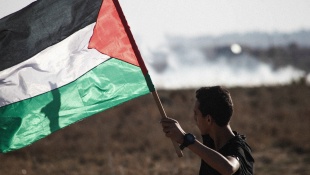
The EU's rhetorical affirmation of defence of democracy, human rights and solidarity is emptied of content by the position taken by the European Council on the situation in the Middle East, where it maintains a complicit silence in the face of Israel's genocidal and colonialist policy, neither condemning it nor denouncing Israel's disregard for the ceasefire agreed in the Gaza Strip in October or in Lebanon. Faced with the havoc in Syria, the European Council is now making completely contradictory appeals, given the destabilisation, interference and instigation of political, ethnic and religious conflicts that the EU has promoted in that country over many years.
The issue of European Union enlargement is approached cynically, sometimes being waved like a “carrot” to encourage candidate countries to pursue so-called reforms – i.e. the neoliberal measures imposed by the EU that benefit economic and financial groups – or being pushed into the distant future by the so-called “internal reforms” it demands in the scope of the EU or by the political impact and budgetary burden it will entail.
In the various decisions taken and positions adopted at this meeting, the European Council is pursuing policies that run counter to the interests of the workers, the people and the Country, with the agreement of the Portuguese Government.
The PCP will continue to denounce such choices, countering them with an alternative path of respect for sovereignty and democracy, development and social progress, peace and cooperation between peoples!